
Goodreads is great, actually*
a lovesong to the literary internet’s most hated website

*Let’s get this out of the way: by “great,” I mean “least bad” in the architectural, design, and support decisions (or, as we shall see, lack thereof) over which a platform has responsibility and control—but this would have made a less elegant headline.
I don’t want to walk the title back too far, though. Especially given the demise of literary Twitter and recent enshittification of Substack (its much-touted “direct relationships” structurally undermined by in-app following), I am surprised enough by the ire directed at Goodreads to legitimately defend it as the best literary social media platform around.
So why do people, and especially authors, hate Goodreads so much?
Mostly because we are egomaniacs. Readers deign to give one star on there! With mean little reviews belying fundamental misunderstanding of our genius! Sometimes they haven’t even read the book they’re rating. Quelle horreur!
Also: it’s owned by Amazon. They don’t invest in it, and the user interface sucks. It foists apocryphal quotes on you like “Happy wife, happy life. —Jane Austen” while it takes forever to load. Duplicate editions and data inconsistencies proliferate. Five-star rating systems are inherently reductive and reward mediocrity. &c. &c.
This second class of complaints I find overblown, if not ironic points of distinction—and in any case outweighed by Goodreads’ superior fundamental indexation vs. competing places to waste time online. Still, these things are worth addressing before we get to the ego stuff, so I will.
Goodreads indexes on book over persona
By which I mean, in a data architectural sense, that “book”—not “author” or “reader” or “user”—is the platform’s primary organizational node. Updates to the home feed anchor to one and only one book; your “shelves” populate with books, not authors. Recommendations, too, are generated at the book level (“Because you enjoyed Camilla . . .”).
Personae are not absent—you can “follow” and “friend” other authors and readers—but they are structurally secondary. You could easily track your reading eschewing all persona-oriented features, but it would be tough and basically pointless to use its persona-oriented features without engaging directly with individual books. There is simply no mechanism for exchange unanchored to one.
In a world where authorial brand has overshadowed text itself at seemingly every turn, a text-based platform that’s not persona-centric is extremely refreshing!
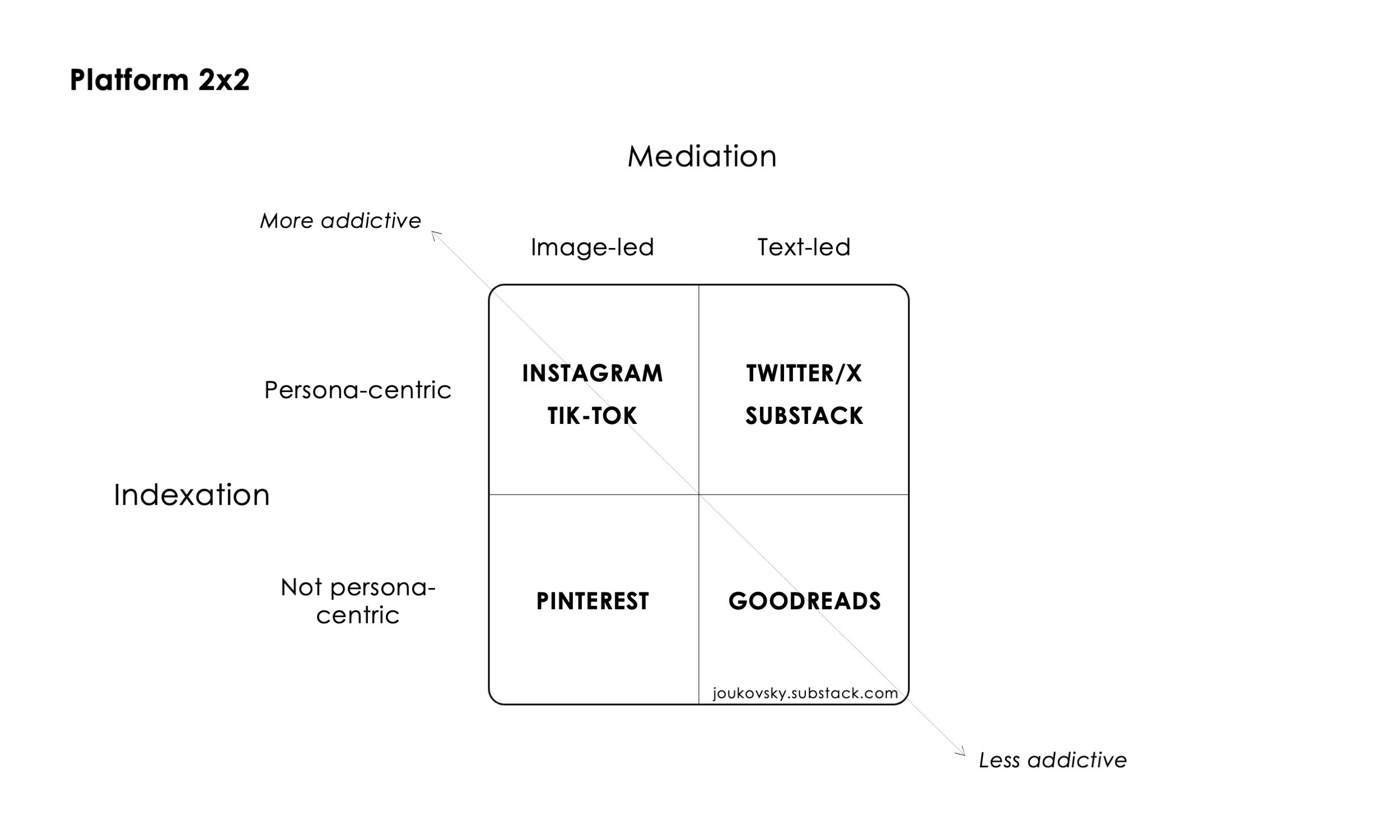
Goodreads’ architecture is also less addictive.
We are visual creatures subconsciously obsessed with positional status strategy.
By indexing on book rather than persona, status metrics such as ratings, review counts, and likes sit a step further from the self. Books and reviews still reflect individual status, but the conversional distance reduces its existential anxiety—and thus compulsive vigilance.
On the mediation side, who can doubt the greater pull of images? The text-based platforms wouldn’t all be pivoting in that direction otherwise.
Then, augmenting these architectural benefits—
Goodreads’ janky user interface makes it less addictive
Do you want to use an unintuitive, ugly-ass website full of garish ads and ninety-degree angles for any longer than absolutely necessary to accomplish what you went there to do?
No.
You wanna open the app, find the book you “Want to Read,” add it, and close it.
The fact that Goodreads still has something like 150 million users in spite of its almost comically horrendous design is evidence that it continues to serve a function beyond its own self-perpetuation; a function with enough value for people to voluntarily use it anyway.
I don’t think it a coincidence that my author page looks like the Facebook profile I set up in 2008, the day I got my college email address. Goodreads has a shitty old interface precisely because it hasn’t been enshittified.
Similarly—
Goodreads’ iffy user support is platform-leading
—the others having no support at all.
Is it even possible to track down a human being from Meta? Or X, aside from tweeting something at Elon himself that happens to turn his eye? I’m not sure Substack’s much if any better on this score.
Goodreads relies on volunteer “Librarians,” “who help ensure the accuracy of information about books and authors in the Goodreads' catalog.” It is possible—on an excruciatingly slow, email basis, but possible—to get individualized support from a Librarian to correct data issues like duplicate editions or wonky stats.
It’s annoying that the bar is this low, but it is. Honestly, bless them.
Goodreads’ ratings and reviews provide a counterweight to in-group sycophancy
Yes, aggregated Goodreads ratings offer basically zero indication of literary quality. Ironically, they tend be unduly harsh of literary fiction.
But individual ratings and reviews are another matter; these run the gamut from idiocy to brilliance, and—unlike the vast majority of competent, careerist reviews in traditional outlets and (likewise often self-serving) alt-lit backlash—reliably give me a pretty good sense of whether or not I’ll enjoy a book.
There are a handful of excellent critics at work today that blow anything on Goodreads out of the water, of course, but they tend to focus on longer, thematic pieces over straight book reviews and can only cover so much ground. Aside from these: I think scrolling through individual reviews on Goodreads often provides more insight into a book than the average professional one.
It’s a matter of separating the wheat from the chaff, and this turns out to be a pretty simple process. You read a few and use your human mind. Elvia Wilk’s distinction between “good faith” and “bad faith” as opposed to “positive” and “negative” reviews is as helpful here as anywhere else:
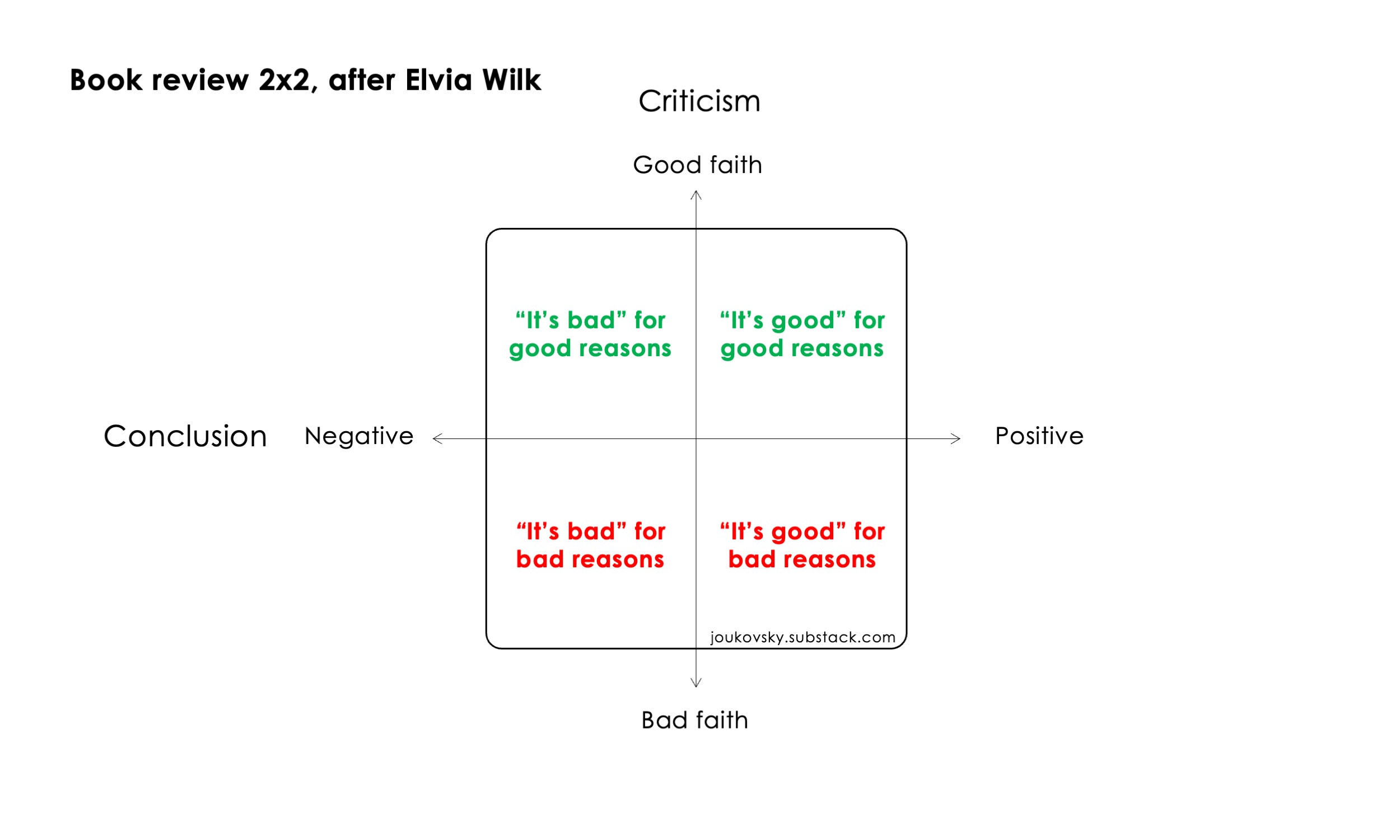
Good-faith reviews lend their perspectives weight; bad-faith ones the opposite. Moronic distain can be a valuable data point in matters of taste.
Which brings us to the ego stuff.
Authorial fear of Goodreads is real, but it’s wrong
Authors and particularly debuts are frequently advised to avoid Goodreads, generally out of well-meaning but misguided concerns related to mental health and professional consequences. “It’s for readers, not authors,” the line often goes, as if authors aren’t definitionally readers, too—“it can only get you into trouble.”
The big fear seems to be that the fragile authorial ego cannot handle criticism and will lash out in some way that prompts users to “review bomb” with one-star ratings—though the only book I distinctly associate with such behavior ended up becoming a New York Times bestseller anyway.
Seems pretty silly to me. You can use the garbage disposal without putting your hand in it. I’ll take this a step farther and argue it’s important to know how to use the garbage disposal responsibly. The garbage disposal is a valuable tool!
It behooves authors to read “good-faith” reviews of their work anywhere
As Wilk puts it:
A Good Faith Review is one of the best things that can happen to any artist. You can be angry about the conclusions (especially if you suspect they are true) but you have to be grateful if a reviewer arrived at unflattering conclusions by taking your work incredibly seriously. Perhaps they are right, which naturally makes you feel bad, but overall this is a positive thing, because your work commanded attention and care. (And yes, in a country with 7 staff book reviewers, all press is good press.)
Attention and care can come from lay readers as well as professional writers. Indeed, the former tend to be more disinterested, with fewer potential conflicts of interest to good faith.
There are plenty of good-faith reviewers on Goodreads—way more than seven. Authors who are in it for the art would be wise to pay attention to what they are saying.
Meanwhile, bad-faith positive reviews still provide a nice ego boost and—
The dumbest and meanest Goodreads reviews can be hilarious
The ur-meme here is that one-star review of Pride and Prejudice about it being “just a bunch of people going to each other’s houses” (or something), but it’s hardly an outlier. I’ve found gems at every star rating.
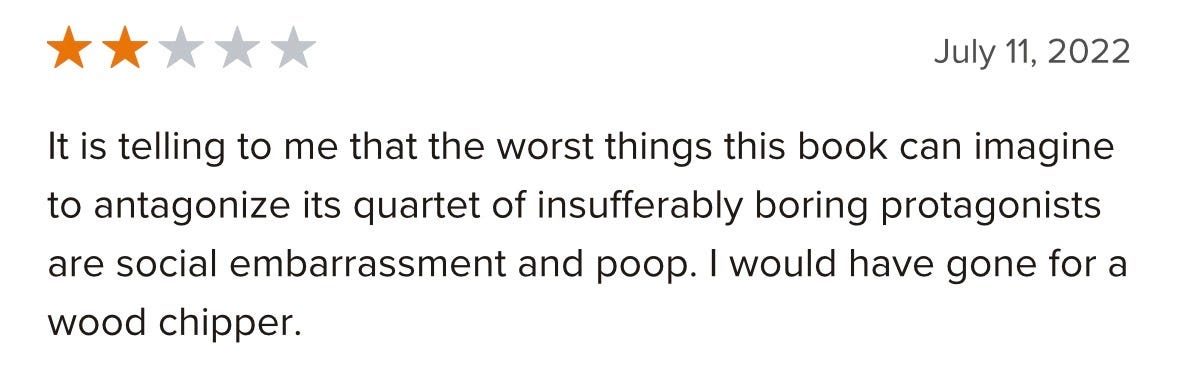
If you have to dig through some garbage to find this stuff, it’s buried no deeper than anywhere else these days.
The most crucial ultimate & supreme moral to remember here is that you should go log in to Goodreads, right now
—to add, rate, and review my novels.
Thanks for reading,
ANJ
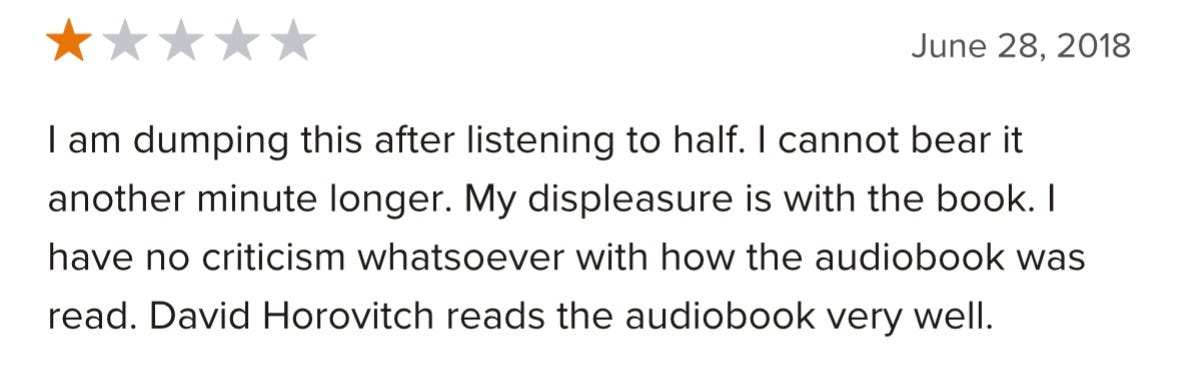
PS—June 3 at 7pm ET Anna Gát and I are co-hosting an Interintellect salon on Edith Wharton’s masterpiece “‘The Age of Innocence’ in an Age of Guilt.” Tickets here. Hope you’ll be inspired to come by this glowing endorsement that is the book’s top one-star Goodreads review—
"You can use the garbage disposal without putting your hand in it" is the perfect way of summing this up! I am still figuring out how I want to go about reading negative reviews of my work one day, but it's helpful to remember that sometimes negative reviews can be so witty we don't even mind 😂
This is really good! The one advantage that a personality forward platform like Substack has is that readers get to know the tastes of a particular critic, and they can use that understanding to inform how they read the reviews. But at a large scale, I have found Goodreads to be a valuable tool in helping me think through books I'm reading. I'm glad to see this mentioned in light of all the "where have the book reviews gone?" discourse.